
‘We don’t want to punish, ban anyone’
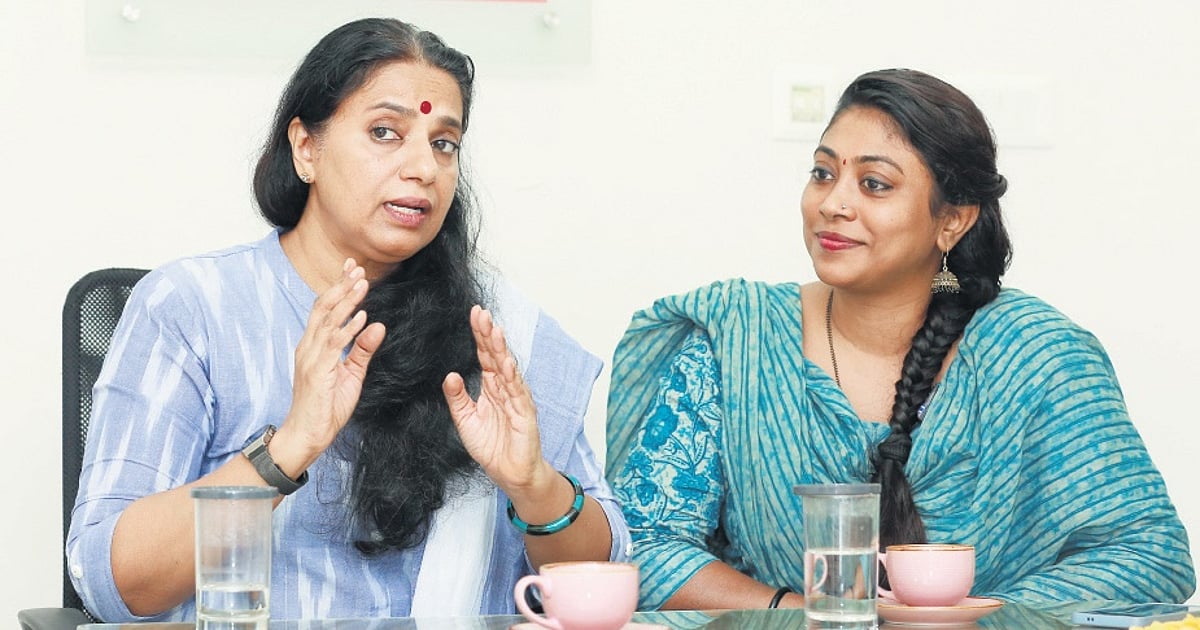
Actor Sheela, as you mentioned, has made a welcome statement. In contrast, committee member and veteran actor Sharada made some comments that were termed regressive. However, that could also be seen as a collective voice of many from that generation. Could you share your thoughts on this?
Jolly: Sheela is also from that generation, so the two people of that generation could have different opinions about how they want to address their workspace personally. It is disheartening that a committee member gave such a statement. She is not denying the issue, but opines that there is no need to discuss the topic openly. This comes from an old way of thinking. I see it as a concern of mothers at home, who think that it is wrong for women to talk about such things in public. It is regrettable that a person with such a mindset was included in the committee.
Divya: I personally feel that when we read the committee report, we can understand the views of these three people (Justice Hema, Sharada and former bureaucrat K B Valsalakumari]. People are not giving the mic to the other two; they are only seeking her [Sarada’s] opinion.
Jolly: People will look for the comments to validate the one that is most prominent in public opinion. In this committee report, there is no conclusion or suggestion that all three people have studied and made together. Women are blamed for many things, like their dressing or behavior. I would say such remarks show the lack of one’s personal development. The conditioning has not changed; some are in the patriarchal value system.
Divya: What we seek is structural changes in the industry…
Jolly: When the industry undergoes structural changes, society’s attitude will change as well. This profession should be open to everyone, creating a belief that anyone can enter it. Also, if we want positive outcomes, we need strong rules and regulations. Otherwise, if it is a namesake, the changes will not be sincere and there is a possibility that they will be brutally rejected. And we may not have this much of a voice tomorrow.
Did you ever feel any pressure like that?
Jolly: It’s not exactly pressure, but we often lose work without explanation. Our names will be on the list, schedules are set, and then suddenly, we are dropped from the project. If we ask why, they just say, ‘It’s cinema…’ Even when the director or writer wants us, we can still be removed. This has been happening for a long time.
Divya: Personally, my workflow took a hit. We understand it clearly, which is why we are speaking up. But it’s fine. We have started talking about it, and now, work will come, and more women will join in.
Jolly: In other industries like Tamil and Hindi, women are creating projects centered on women’s stories. Men should be able to do this, too. But, with the current power structure, many struggle to make films, and producers face a lot of pressure. Directors and producers alike suffer due to power games. If more people were gender-sensitive, we could see more stories like that. If women had the power to produce, write scripts, and make films, the industry’s view of women would change — they would not be seen only as actresses, but placed differently. Unfortunately, this is still lacking in our industry.
You are speaking very openly now. Do you worry that this might affect your work?
Jolly: I have never had such fears. My positive and negative sides are that I don’t respect structural hierarchy. I believe in giving equal respect to everyone. I’m not part of any religion, political party, or group. Despite the risks, my greatest comfort is my freedom to express my opinion without looking around. I am not going to live for 500 years, and I don’t view life as human-centric. With that conviction, I have no fear. We all have to die eventually, so I choose to die peacefully.
Divya: When I first started speaking out, I was scared. But there is a push from within – that it’s not just about me. For instance, I decided to speak out against the actor who misbehaved with me after realising that it was not a mistake or a one-off incident – the person had behaved in a similar manner with some other artistes too.
In this profession, many people don’t even realise the issues, and some believe it’s their duty to perpetuate them. We often don’t fully grasp the impact of speaking out until it affects us personally. Despite this, we continue to speak up. It’s tough when there is no work because we are not just activists; we are trying to make a difference from within our field. In 10 years, people might wonder where these women are.
Jolly: We are the ones who drove P K Rosy away. In the 96-year history of our industry, we know what happened to that Dalit girl. Our struggle is never easy. No matter how much progress we make, there will always be challenges for some people. I depend entirely on this work, with no other job or income source, so there are fears. But living with fear is not useful; it’s better to live with hope.
Divya: In the last five years, people began inquiring about us only after the Hema Committee report. I am in my 26th year, and I have struggled to find jobs that I love. We have personal lives beyond our profession. It’s crucial to understand and change this situation. Malayalam cinema is celebrated worldwide for its creativity and it should also be celebrated for its professional and systematic structure.
Jolly: Not only that, our industry is small, but we have managed to create such a big movement, which is a major achievement for us. One of our strengths is our high level of democratic awareness. The notion that the industry might be destroyed is baseless because art, especially cinema, is essential and cannot be eliminated from society. Cinema is an integral part of our existence.


Leave a Comment